

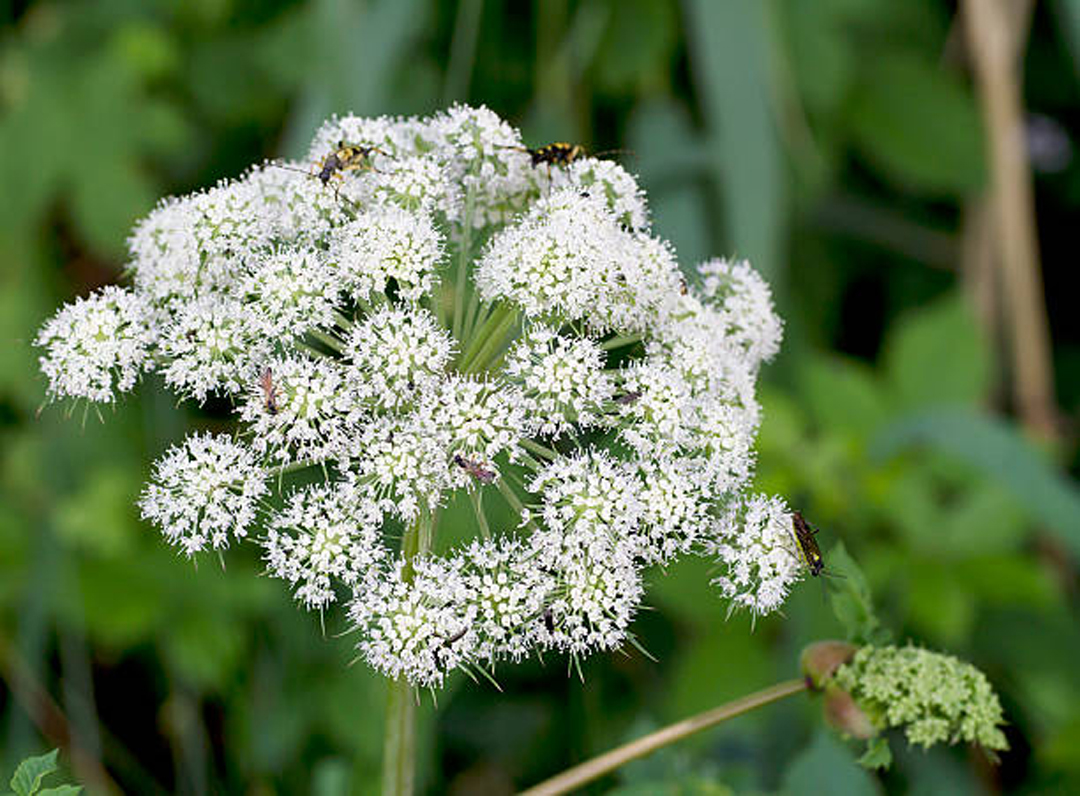
Angelica has serrated, bright green leaves and branching, hollow stems with a celery-like texture. The round, whitish green flower-heads bloom in late spring in the second year of growth. When not allowed to flower at all by frequent cutting of the stems, the plant will continue to flourish for several seasons instead of for the customary two years. Angelica is completely permeated by a unique essence, giving it a delicately sweet and refreshing aroma.
History and mythology
The history of angelica goes far back into the legends and folklore of Northern Europe, and in particular the countries of Lapland, Iceland, and Russia. Because of its wonderfully benign qualities, both in the physical and spiritual realms, the plant held an important place in pagan rites, and later in Christian festivals. According to legend, during the Middle Ages, an angel appeared to a monk in a dream and revealed that angelica would cure the plague. This is why the herb was called angelica, the guardian angel.
Cultivation
When sowing angelica, it is very important to use only fresh seed, as the germinating period is very short. The seed can be sown in prepared boxes, or in the open ground. When seedlings are about
3 inches (8 cm) high, plant them out 3 feet (90 cm) apart in a moist and shady position. Rich soil and some shelter are essential for maximum growth. In poor ground, plants will become stunted and the leaves yellow.
Harvesting and processing
Harvest the seed just before it starts to fall, by snipping off and drying whole flower-heads. Sift out any dried husks and stalks, and store the seed in airtight containers for household use. But if required for sowing, plant the seed out within a week at the most. The stems can be cut and used at any time; however, their full flavor and size are best just after flowering. Root is kept by digging, cleaning and keeping it in an airy, dry place till desirable. Leaves are cut from the stems and placed on sheets of clean paper or racks, in a shaded, warm place till dry. When stiff, crumble them into sealed containers.
Various uses
Culinary
A few young angelica leaves may be added to salads. The hollow stems and stalks can be crystallized and used for decorating sweets and cakes, and if you do not candy your own stems, they can be bought in many shops. The stems and stalks, either candied or fresh, give their sweet flavor and goodness to stewed fruits, especially acid fruit like rhubarb and plums, and to jams and jellies. The roots can be cooked and eaten like a vegetable.
Medicinal
Angelica was valued as a protection against all sorts of infections. It was used to aid digestion. One old remedy for flatulence directed that the stalks be slowly chewed until the condition was relieved, which was good instruction, as it was seen discovered that pectin is one of angelicas components, an enzyme acting on food digestion. Another of the plant’s components is a resin stimulating to the lungs and to the skin. In the cold countries where it was known best, angelica was prized for a sensation of warmth when it was eaten or taken as a tea. (A tea can be made from either the leaves, stems, seeds, or the dried root.) Modern-day herbalists still recommend angelica tea to calm the nerves, to relieve colds and influenza, and as a long-term preventive against winter illnesses. Many available herb tea blends contain angelica for its therapeutic properties and for its pleasant flavor. A number of the old herbalists regarded angelica as the most powerful of all medicinal plants, every part of it roots, stems, leaves, and seeds having health-giving properties. People with a tendency to diabetes are warned against it however, as it may increase sugar in the urine. The subtle aroma which suffuses the whole herb makes it an important ingredient in many luxury beverages, including vermouth and some liqueurs, such as Chartreuse. The earliest liqueurs were prepared in medieval monasteries, originally as medicines.
Cosmetic
Angelica seeds are used in the making of some perfumes. Dried angelica leaves go into a potpourri mixture and are an ingredient in sweet-smelling herb pillows. Use fresh or dried leaves (in a muslin bag) in a hot bath for relaxation and fragrance.
Companion planting
It has been noted that the common stinging nettle (Urtica dioica), when grown near certain plants, intensifies their essential oil content. In the case of angelica, this is increased by as much as 80 percent.