

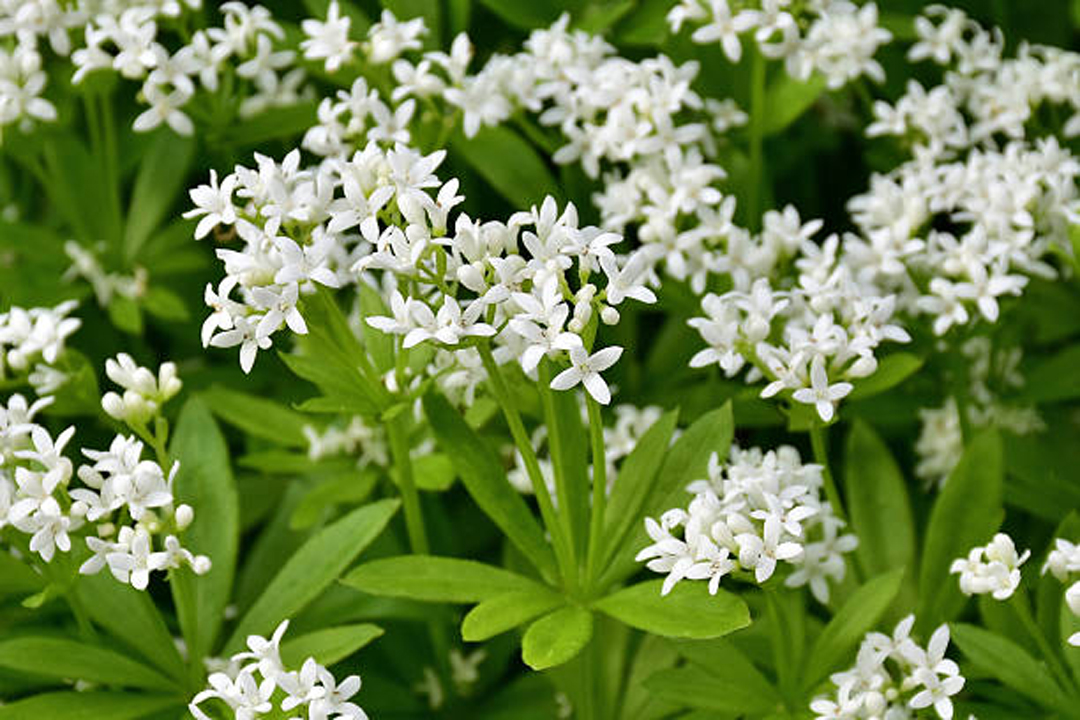
Sweet woodruff has dark green leaf whorls shaped like pointed stars; their stems are attached to a creeping root system which eventually forms a massed ground cover. In mid-spring to early summer, white, fragrant flowers appear in clusters rising above the foliage. This attractive herb is found growing in woods and on shady banks.
History and mythology
Woodruff is distributed throughout Europe where it is often seen carpeting woods; it is also found in Asia and North Africa. When introduced to America it became universally popular and now grows wild there too. It is especially esteemed in Germany where fresh sprigs are steeped in white wine for making a favorite beverage (which is also a digestive tonic) called maibowle, and is traditionally drunk on the first day of May. Woodruff was also highly regarded by the French, the old name for it being muge-de-boys (musk of the woods). Early English names for this herb were wud-erove and wood-rova.
Cultivation
Ripe woodruff seeds are sown in late summer to early autumn (fall) into moist, loamy soil in a shaded area. Otherwise, divide the roots after flowering has finished and select the same kind of soil and shade conditions as the seeds, placing the roots firmly into the ground about 1 foot (30 cm) apart.
Woodruff grows to approximately 1 foot (30 cm) high and, as a shade lover, the leaves stay dark green unless they are exposed to sunlight which makes them paler. It is difficult to grow this herb successfully in climates where summers are humid. We saw woodruff carpeting the ground under shrubs in North America during a hot, but dry summer. Flourishing woodruff plants also do well in Hobart’s Botanic Gardens where the cooler climate obviously suits it.
Harvesting and processing
When harvesting sweet woodruff, cut the flowering stalks almost to ground level, and dry them on airy racks in a shady place, or tie the stalks loosely together in bunches and hang them to dry. When leaves and flowers are crisp, rub from their stalks and put into airtight containers. Freshly gathered leaves do not have the unique aromas of the dried herb which has the special fragrance of freshly cut hay and lasts for many years. The green leaves were often pressed between the pages of books, where their star shape lies flat and thin, giving the paper a delicate scent a practice still worth following. The dried herb was also mixed with roses, box, and lavender to perfume linen and to repel insects.
Various uses
Culinary
Sweet woodruff is not known as a culinary herb, although the tiny fragrant flowers make a delicious embellishment to a salad. However, woodruff is renowned for its addition to drinks, the most famous being the German maibowle, when newly picked leaves are steeped in white wine as a celebration drink on the first of May. The fresh or dried leaves and flowers make a delightful tea.
Medicinal
In the Middle Ages sweet woodruff was made into a decoction and taken as a diuretic. It was also given to relieve stomach pains, to assist digestion, and taken as a tonic. The fresh leaves were bruised and put onto cuts and wounds for their healing effect. As a tranquillizer, Culpeper recommends an infusion of 1 oz (28 g) of the dried herb to 20 fluid ounces (600 ml) of boiling water; 2 teaspoons to be taken three times a day.
Cosmetic
This is not an actual cosmetic herb, although useful in facial steam baths. Woodruff is an excellent addition to potpourri for its lingering subtle scent. The powdered leaves are used to enhance certain snuff blends, and beds were once stuffed with dried woodruff when warmth from the body would induce deliciously scented sleep. Garlands and bundles of flowering woodruff were hung in houses to cool and freshen hot summer air. At this time of year woodruff was gathered and strewn on the floors of houses and churches to impart its scent, and to effectively repel insects. A crystalline chemical constituent of woodruff, called coumarin, is used in perfumery for its characteristic aroma and its value as a fixative.
Companion planting
Sweet woodruff is excellent for under-planting in orchards, rose beds, shady borders, and in woodlands.