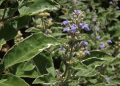


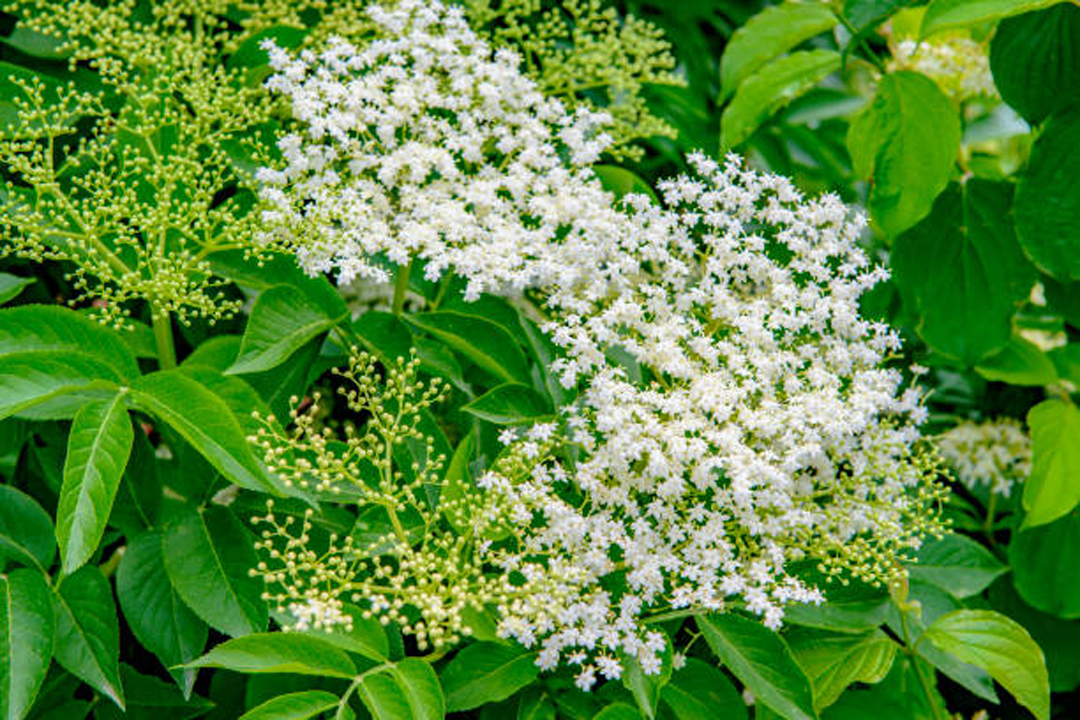
The elder described here (S. nigra), the “black” elder (so called because of its dark green foliage), is the most useful kind for the herb garden, although there are other varieties with decorative golden, white, or variegated leaves. However, when these trees carry flowers and berries, they do not have the same therapeutic qualities as the black elder. There is also a dwarf elder with valuable medicinal properties, although it is advised not to grow this one as several parts of the tree can be poisonous if taken internally, especially the berries, which yield a blue dye. The black elder has finely serrated leaves advancing in pairs along supple, pale green stems clinging to bronze, woody branches. It is a deciduous tree, or shrub, and becomes thick and dense as it sends up many suckers. The elder seems to have two distinct seasonal personalities. In summer and early autumn (fall) it is veiled in filmy heads of cream flowers (a neutered haven for bees), looking like a gorgeous bride in billowing lace. Then in late autumn (fall) as the blooms form fruit, the tree changes its appearance and becomes withdrawn and stately, the sprays of ripened berries (a feast for birds) clothing the dowager-tree in a rich garnet robe. Eventually all falls away, and winter strips the branches bare, waiting for spring to bring fresh green buds and a new cycle.
History and mythology
All parts of the elder are useful, it having once been called “the medicine chest of the country people.” The close-grained white wood of old elder trees was cut and polished and made into butchers skewers, shoemakers’ pegs, needles for weaving nets, combs, mathematical instruments, and some musical instruments. The stems with pith removed made whistles and popguns for country boys. The elder grows wild in many parts of Europe and belongs to the folklore of a number of countries. The Anglo-Saxons called it Eldrun. Danish legend connected it with magic, believing that in the branches dwelt a dryad, Hylde-Moer, the Elder Tree Mother, and that if one stood under the tree on Midsummer Eve one would see the King of Fairyland and all his train ride by. Russian peasants said that the compassionate spirit of the elder would drive away evil and also give long life. The Sicilians thought that sticks made of its wood killed serpents and drove away robbers, and in England it was held that the elder was never struck by lightning.
Cultivation
When propagating elder, we have had the greatest success by taking 6 inch (15 cm) hardwood cuttings in late winter before shoots appear, and putting them in a container of river sand. Tip cuttings can also be struck in river sand in late spring when new growth has firmed. When roots appear the cuttings can be planted out, or put into containers with potting mixture. It is also possible to strike cuttings of sprouting wood in early spring in the open ground. Suckers, with some root from the main plant attached, can be dug and transplanted throughout the year, unless winters are harsh, when you may lose them. Elder trees grow almost anywhere but do best in a sunny position in rich, moist soil. If planting a grove of trees, leave at least 10 feet (3.5 meters) between each one.
Harvesting and processing
As elder trees have a long flowering period from summer to autumn (fall), harvesting them may be an ongoing, leisurely task. Gather the blooms when all the tiny buds on each pearly cluster are open, and do this by midday before the sun draws out too much of the flower’s etheric substance. Put the heads somewhere shady to dry a sheet of paper in the linen cupboard will do and when they shrivel, looking like fine, yellowed crochet, remove them to make room for more fresh flowers. Store the dried ones whole in airtight boxes or jars, or rub them from their frail stalks first. Leave some flowers on the trees for using fresh and to ensure that there will be some fruit later. When the shiny green berries form in autumn (fall), watch them ripen and pick them as they begin to turn reddish purple. If it is not convenient to use the berries at once, allow them to dry, and store in airtight containers. They keep their flavor well and are used like dried currants.
Various uses
Culinary
A delicious wine is made from fresh elderflowers. Elderflower fritters are an unusual and epicurean dessert. Elder blossoms give a muscatel grape flavor to gooseberry, apple, or quince jelly when tied in a muslin bag and boiled in the fruit syrup for 3 or 4 minutes at the end of cooking time. A friend tasted an elderflower sorbet between courses at a dinner party, and pronounced the flavor exquisite.
Elderberries taste rather like blackcurrants, and flavor some jams and jellies; or they may be used on their own to make jam or jelly, chutney, and ketchup. The berries also give a distinctive sharp taste to fruit tarts and apple sauce. Elderberry wine has long been a favorite country elixir.
Medicinal
Elder tree bark was used long ago as a purgative by Hippocrates, and a soothing ointment was made from the green inner bark. A tea infused from the root was considered the best remedy for dropsy. The uses of the flowers and berries are legion. A strained infusion of the dried or fresh flowers is excellent for alleviating inflamed eyes. Elderflower tea (sometimes together with peppermint leaves) is an old remedy for influenza and, taken every morning, was also popular as a spring medicine to purify the blood; an ointment made from the flowers heals burns and chilblains. The leaves are also used in ointments, and as a wash, to repair and soothe the skin. Elderberry wine has valuable medicinal qualities, including the relief of sciatic pain. Once it was recommended to mix some elderberry juice with port wine for treating rheumatic and neuralgic distress. A cordial known as Elderberry, when taken hot before going to bed, was a well-known cure for a cold. Elderberry juice was used as a laxative and for colic.
Cosmetic
A cooled elderflower infusion, or tea, is very effective when patted on the skin to fade freckles and to take the sting out of sunburn. In fact this simple treatment is good for the complexion generally, and if kept up regularly gives the skin a soft, dewy bloom after a week or so. Elderflowers are still used today in the making of many herbal cosmetics.
Companion planting
An infusion of bitter elder leaves dabbed on the face is advised to repel insects such as mosquitoes and flies, a decoction of the leaves sprinkled over delicate plants helps ward off aphids and caterpillars, and the leaves spread about where grain is stored drive away mice. It has been noted that elders growing near compost heaps assist fermentation, and that humus under the trees is especially light.