

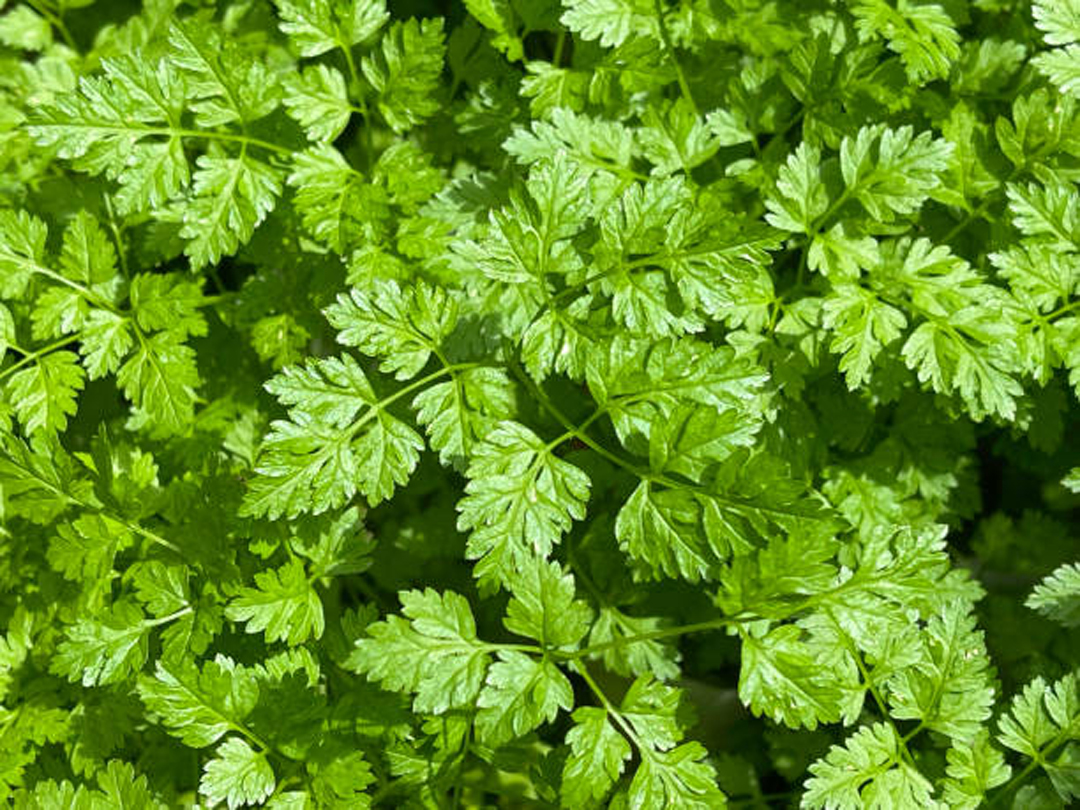
Chervil plants grow to 12 inches (30 cm) high and in appearance they resemble parsley, although the fern-like leaves are smaller and finer, the color is a brighter green, and the flavor has a mild taste of aniseed. The white flowers, which appear in early summer, grow in small, flat umbels, and the seeds which follow look rather like caraway seeds, except that they are a little longer and thinner. Chervil is native to Eastern Europe.
History and mythology
Chervil was taken to various countries by the colonizing Romans, who well knew its worth in food and in medicine. On the Continent, chervil soup has been traditional fare for Holy Thursday, as well as being a favored dish at other times. One expert mentions that chervil was one time named myrrhis for its unstable oil that has a comparable fragrance to the resinous substance of myrrh.
Cultivation
Chervil is sometimes classed as a biennial, but it is best treated as an annual. The seeds can be sown in spring and autumn (fall) in a well-prepared garden bed. Never plant them in a seed box, as chervil seedlings are too fragile to transplant. Sow the seeds in shallow drills 12 inches (30 cm) apart, cover them with soil, and firm down with the back of a spade. When the seedlings are big enough to handle, thin them out, leaving 4 inches (10 cm) between plants.
Keep chervil watered at all times.
This herb is frost-tender and in cold areas it needs to grow in a sheltered position. It also dislikes hot, dry conditions, so try and protect the plants from the summer sun. A good idea is to grow chervil under a deciduous tree so that it is shaded in summer by the leafy boughs, yet is also warmed by the winter sun when the branches are bare. As the plants never grow large, chervil is ideal for cultivation in containers. Select a tub or pot 12 inches (30 cm) in diameter, fill it with a good, porous potting mixture and scatter the seeds over the surface. Press them gently down with a flat piece of board, and lightly sprinkle with water. Keep the pot moist, and when the seedlings are 2 inches (5 cm) high, thin them out to 3 inches (8 cm) between plants.
Harvesting and processing
Chervil can be picked at any time of the year. Break the stems off carefully, taking the outside leaves first, as with parsley, so that the new center leaves are allowed to grow. If you wish it to self-sow, which it will do readily, do not harvest all the plants when in flower: leave a third to go to seed. The foliage is dried by spreading the sprays out on a wire rack in a cool, airy place away from the light, which will fade the green color. When brittle, crumble the leaves from the stems and store in airtight containers. Fresh chervil leaves may be chopped finely, mixed with a little water, and frozen in ice cube trays to be used when needed. Chervil butter, made by pounding chopped chervil leaves into softened butter, then cutting into squares when cold, may also be frozen in sealed polythene hags.
Various uses
Culinary
Chervil is one of the four fragrant herbs which make up the delicate bouquet, “fines herbes,” the others being chives, tarragon, and parsley in equal parts and all finely chopped. Chervil’s soft leaves make it indispensable for sprinkling over food when cut up finely, both as a garnish and a flavoring. Sometimes whole sprays may be used for garnishing. Chervil should never be cooked for more than 10 to 15 minutes, otherwise the fine flavor will be lost. Use this herb in chervil soup and in many types of sauces. Fold into scrambled eggs, omelets, creamed potatoes, and cream cheese. Sprinkle it liberally on salads and use it as a filling for sandwiches. Chervil goes with poultry and fish and is excellent sprinkled on cooked, crisp vegetables with a little melted butter and freshly ground pepper and salt.
Medicinal
Chervil has been traditionally valued as a blood purifier and for this reason it was widely eaten in the spring. It was known to help the kidneys and was taken to ease rheumatic conditions. Externally, a poultice of the leaves helped disperse swellings and bruises. Dr. Nicholas Culpeper advises in his Complete Herbal that “The garden chervil being eaten, doth moderately warm the stomach …”
Cosmetic
Chervil’s cosmetic value lies in its cleansing properties as a blood purifier, thus paving the way for a clear and healthy complexion.
Companion planting
Chervil and radishes help each other in companion planting, radishes growing near chervil having a hotter taste. It has been reported that a steeped tea made from equal parts of chamomile, chervil, and lemon balm, applied in a compress, is helpful in curing hoof rot in animals. Chervil is one of many aromatic herbs that aid vegetables when grown amongst them.