
Plants
    • Home
    • Bulbs
    • Medicinal Plants
    No Result
    View All Result
    • Home
    • Bulbs
    • Medicinal Plants
    No Result
    View All Result
    Plants
    No Result
    View All Result

    Lonicera

    Rhizome by Rhizome
    March 12, 2023
    in Acidic Soil, Full, Partial, Perennial, Red, Shrub, Spring, Summer, Well drained, White, Yellow
    0
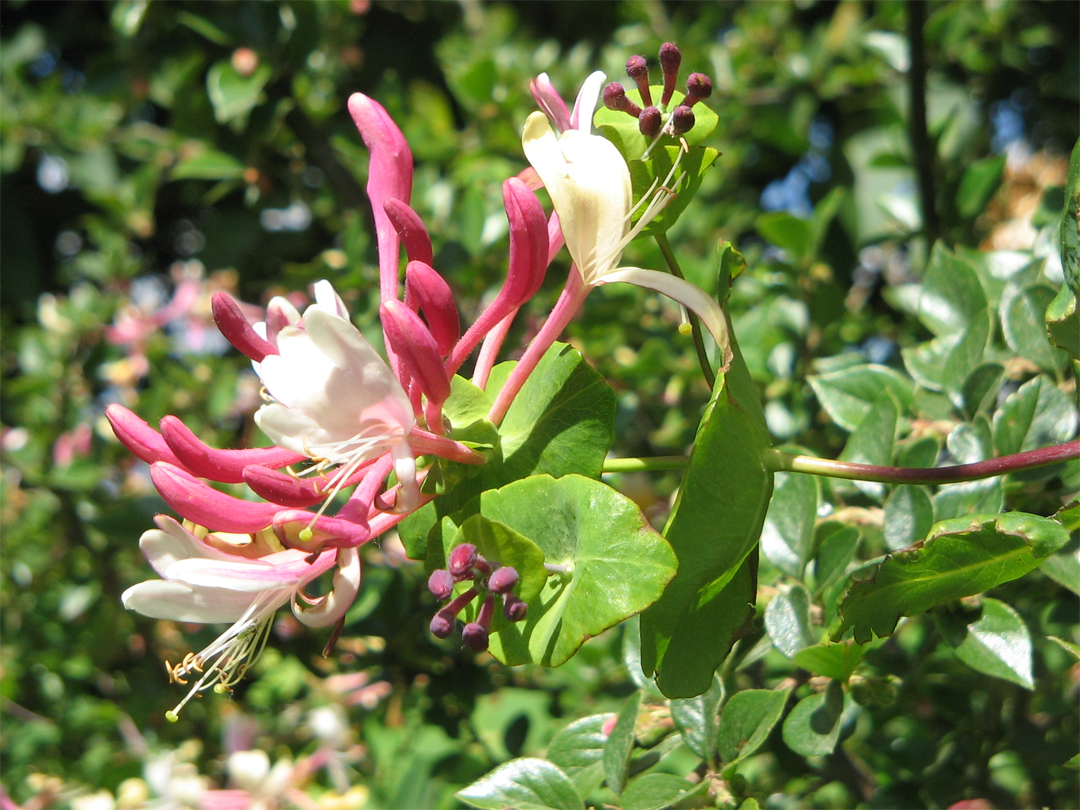
    Lonicera

    The two species that were most often recommended for medicinal purposes are L. periclymenum (woodbine, wild or common honeysuckle) Has whorls of very fragrant, creamy-white to yellow, tubular two-lipped flowers, followed by red berries. L. Capri folium (Italian, Dutch or per foliate honey-suckle) has upper leaves surrounding the stem and creamy-white to pink flowers. Both are fully hardy, L. periclymenum grows to 7 m (23 ft.), L. Capri folium to 6 m (19 ft.). L. japonica Japanese honeysuckle) often has violet-tinged white flowers, which are followed by black berries.

    History and traditions

    Various species of honeysuckle have been used since ancient Greek times for their medicinal properties. Dioscorides is quoted by Gerard as recommending the seeds for “removing weariness” and “helping the shortness and difficulty of breathing” and syrup of the flowers for diseases of lung and spleen. Little used medicinally today, honeysuckle keeps its place in the herb garden as a fragrant climber, memorably described by Shakespeare as the “lush woodbine” and “sweet honeysuckle” which “over-canopied” Titanic’s bower (A Midsummer Night’s Dream). The name honeysuckle comes from the old practice of sucking the sweet nectar from the flowers.

    Growth

    Grow in fertile, well-drained soil in full sun or partial shade. Propagated by seed sown in late summer to autumn in containers and overwintered in a cold frame, or by semi-ripe cuttings taken in summer. Prune out straggly or overgrown branches.

    Parts used

    Flowering stems.

    Uses

    Medicinal

    Capri folium and L. periclymenum were formerly used for their expectorant, laxative properties. L. japonica (jin yin hua) is used in traditional Chinese medicine for clearing toxins from the system.


     

    Previous Post

    Indian tobacco

    Next Post

    Gipsyweed

    Next Post
    Gipsyweed

    Gipsyweed

    Leave a Reply Cancel reply

    Your email address will not be published. Required fields are marked *

    Recent Posts

    Common Changes in the woman’s body after childbirth and how to manage them.

    Common Changes in the woman’s body after childbirth and how to manage them.

    March 20, 2023
    Ginger

    Ginger

    March 16, 2023
    Chaste tree

    Chaste tree

    March 16, 2023
    Sweet violet

    Sweet violet

    March 16, 2023
    Greater periwinkle

    Greater periwinkle

    March 16, 2023
    Vervain

    Vervain

    March 16, 2023
    Mullein

    Mullein

    March 16, 2023

      We don't provide medical advice or make any recommendations regarding specific health concerns via this website. Information provided in this content is for educational purposes only and should not replace the advice of a qualified healthcare professional. It is crucial to consult with a physician or other healthcare provider before starting any nutrition, supplement or lifestyle program, especially if you are currently taking any medications. The responsibility for any health consequences resulting from following the information in this educational content lies with the individual reader, and neither freeflowerbulbs.com nor the publisher assumes any liability.


      © 2023 www.freeflowerbulbs.com

      No Result
      View All Result

        We don't provide medical advice or make any recommendations regarding specific health concerns via this website. Information provided in this content is for educational purposes only and should not replace the advice of a qualified healthcare professional. It is crucial to consult with a physician or other healthcare provider before starting any nutrition, supplement or lifestyle program, especially if you are currently taking any medications. The responsibility for any health consequences resulting from following the information in this educational content lies with the individual reader, and neither freeflowerbulbs.com nor the publisher assumes any liability.


        © 2023 www.freeflowerbulbs.com