

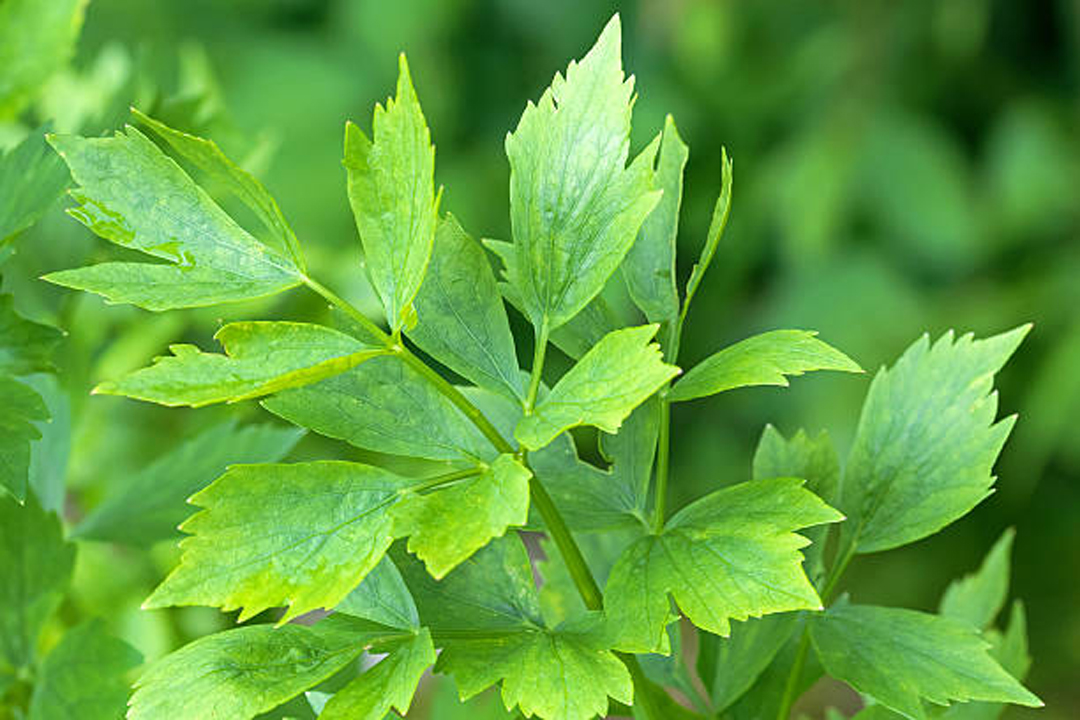
In appearance, lovage bears a resemblance to angelica, although it does not grow as tall or as densely. The flowers are smaller and sulfur yellow, while angelica’s great round heads are white to lime green. When young, lovage plants also look like a rather obscure herb called smallage, said to be the forerunner of our modern celery. Lovage’s slim, hollow stems bear flat, serrated, dark green leaves in threes branching out from denser, directed stalks. Yellow flowers are trailed by oblong brown seeds.
History and mythology
Lovage originated from the Mediterranean region and is one of the lesser known herbs today, yet it was formerly employed a great deal in medicine and cooking. In ancient times it grew wild in the mountainous districts of northern Greece and the south of France. It found its way to Britain many centuries ago and became one of the most cultivated of English herbs for use in herbal medicine for its root, stems, leaves, and seeds.
Cultivation
Like angelica, lovage likes rich, moist soil and a rather shady position to grow well. The seed can be sown in prepared boxes, or in the open ground in spring. When seedlings are about 3 inches (8 cm) high, plant them out to ½ feet (45 cm) apart. Keep them watered in dry weather.
Harvesting and processing
Harvest the seed just before it starts to fall by snipping off and drying whole flower-heads.
Sift out any dried husks and stalks and store the seed in sealed vessels. Stems are cut and utilized any time. If it is candied like angelica stems, the flavor is best just after blossoming. Root can be stored by burrowing, cleaning, and keeping in an airy, dry place till required. Leaves, for making into a tea or for cookery use, may be cut from the stems and placed on sheets of clean paper or racks, in a shaded, warm place till dry. When they are breakable, beat them into sealed containers. Freezing for culinary use can be done by chopping the leaves finely and mixing them with a little water and putting them into ice cube trays. Whole leaf sprays might be kept for numerous weeks in the freezer when closed in foil.
Various uses
Culinary
The flavor of the leaves resembles a combination of celery and parsley, but predominantly celery, with an extra peppery bite. They make an excellent, healthful addition to salads, soups, stews, and some sauces. For those on a condiment-free food, use lovage for its hot spicy flavor. Chop the leaves finely for best results, as they are a little coarse. Hollow stalks and stems are frequently conserved as a confectionery in the similar way as angelica.
Medicinal
The roots, stems, leaves, and seeds of lovage were used in herbal medicine for stomach disorders and feverish attacks. An infusion of the root was considered beneficial in many illnesses, including jaundice and urinary troubles. A decoction of the seeds was recommended as a gargle for infections of the mouth and throat, as a drink for pleurisy, and as a lotion for bathing sore eyes. Leaves consumed raw in a salad, or suffused dry as a tea, are still renowned as being inspiring for the digestive system and helpful in remedying gynecological disturbances. In distinct regimens, the cut leaves are an wonderful replacement for pepper as well as other hot spices. Lovage was also regarded as an important pot herb in days gone by. In some regions where fresh vegetables are scarce, the roots are used for food and it is supposed that munching the stems may help avoid infection.
Cosmetic
Lovage is supposed to be a freshening herb, both in solutions for the external of the body, and as an internal cleaner for the system so as to get a clear skin externally. After an active day, when one has perspired freely, try a lovage bath as an all-over body freshener. Make a strong tea with the leaves and add to a hot bath, or pick fresh leaves, bruise them and put them straight into the bathwater. This is a very old custom going back beyond the middle ages.
Companion planting
Lovage, as an aromatic herb, has a generally beneficial effect in the garden when sown in small patches, or as a border. Aromatic herbs have a particularly enlivening effect on the more stolid vegetable plants such as potatoes, swedes, and other root vegetables.