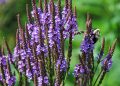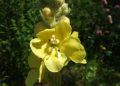



Mustard plants are upright with branching stalks bearing smooth, bright green, pointed leaves with notched edges. The small yellow flowers, bunched tightly together, appear from early summer until autumn (fall). The reddish brown to black seeds that follow are encased in erect-growing pods, each containing about 12 seeds. There is also a white mustard, Brassica alba-, the leaves are not used as widely as those of Brassica nigra, also known as mizuna.
History and mythology
Mustard plants are widely distributed throughout Europe (except in northern areas) in northern Africa, parts of Asia, parts of India, and in North and South America. Ancient Greek physicians prescribed mustard seeds for various medicinal purposes, and the Romans are said to have eaten mustard leaves as a green vegetable. It was also an ingredient of soups and salads and helped to cleanse the system.
Cultivation
Mustard seeds are sown in spring in prepared loamy soil and firmed into shallow drills 1 foot (30 cm) apart in an open, sunny position. When grown as a seed crop for commerce the seed is broadcast over the field. Mustard germinates quickly and has green shoots within a week of sowing. Successive sowing is necessary for continual use of the leaves.
This is the same mustard which is often sown with cress in punnets for cutting. Children used to grow mustard and cress on wet blotting paper, but now there are more entertaining ways of doing this. Porous terracotta animals are available in different sizes and shapes with deep grooves incised into their bodies. Seeds are placed into the grooves of a dampened animal, which must be kept moist for the seeds to sprout and grow. Standing the animal in a shallow container of water ensures that shortly it will develop a green “coat” a couple of inches long when it is ready to cut. The process then begins all over again.
Harvesting and processing
For mustard greens, cut the plants when large enough and before they flower. Repeated sowings can be done throughout the growing period. For harvesting the seeds, wait for the pods to swell, then harvest and allow to dry out. Remove seeds, and if necessary dry them further before storing in clean, dry, covered containers.
Various uses
Culinary
Mustard leaves have a pleasing hot flavor, which makes a pleasant contrast to other salad greens. The leaves were once used on their own as a green vegetable and were put into spring soups. The strong flavor can overwhelm the palate, so for a piquant taste with wider appeal add a few leaves when cooking spinach, or to enliven pureed soups. The ripe seeds are collected for grinding to make mustard, and for marketing whole in jars for the spice cupboard.
Medicinal
It was widely accepted that mustard greens helped clear the blood in spring after a long winter’s stodgy food. This was a time when wild herb soup was made from a mixture of specially selected young leaves and green shoots gathered from hedgerows and fields, including mustard leaves. Powdered mustard seeds were used in poultices to relieve chest congestion and rheumatism, and in hot water as a foot bath to appease the common cold.
Cosmetic
Mustard leaves or seeds are not known for their cosmetic use in Western countries.
Companion Planting
Mustard is often grown for its alkaline properties, which will counteract too much acid in the soil. The crop is also good for ground that has been damaged after too much mineral fertilizer, but continual mustard planting depletes the soil.