
Plants
    • Home
    • Bulbs
    • Medicinal Plants
    No Result
    View All Result
    • Home
    • Bulbs
    • Medicinal Plants
    No Result
    View All Result
    Plants
    No Result
    View All Result

    Yew

    Rhizome by Rhizome
    March 15, 2023
    in Full, Green, Loamy Soil, Neutral Soil, Partial, Poisonous, Sandy Soil, Shrub, Spring, Tree, Woody, Yellow
    0
    Yew

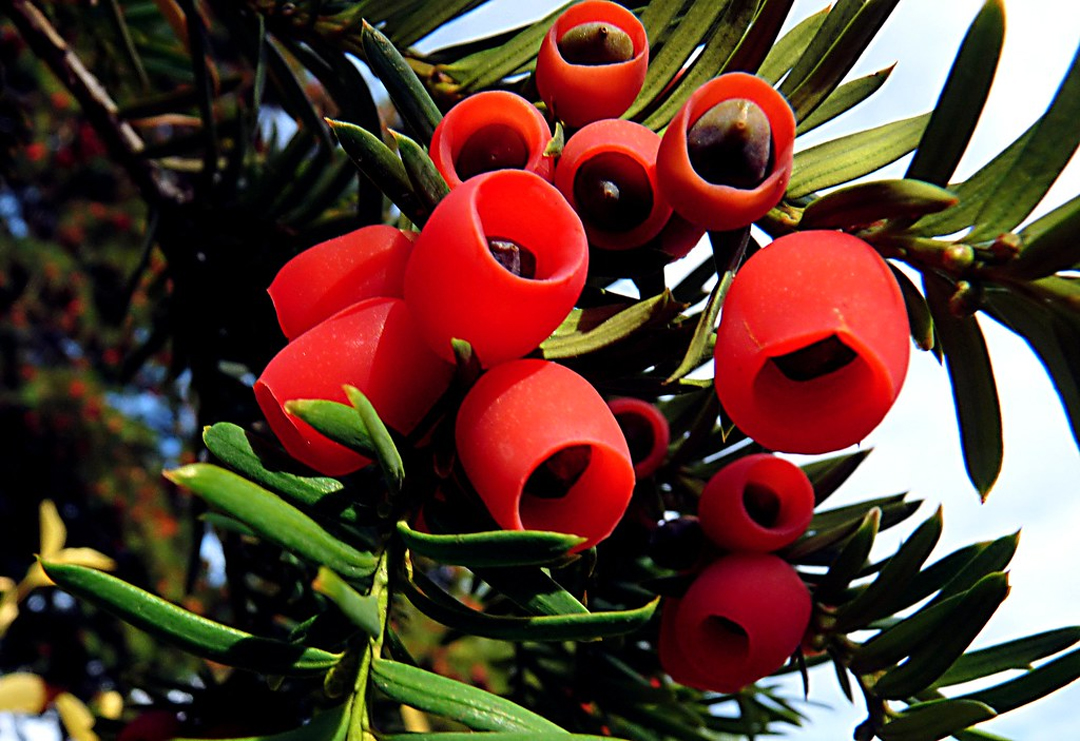
    Taxus baccata is a spreading, evergreen tree, growing to about 15 m (50 ft.), with a rounded crown and reddish-brown scaly bark. The leaves are dark-green, flattened needles, arranged alternately. It is a dioeciously tree, and the male flowers are small! globular cones, which release clouds of pollen in very early spring; the female flower is a small green bud, followed by the fruit, a highly poisonous seed, partially enclosed in a fleshy, red, non-poisonous aril.

    History and traditions

    Yews were sacred to the Druids and used in their ceremonies. They have also been grown in churchyards from the beginning of the Christian era. As evergreens and exceptionally long-lived trees (1,000-2,000 years), they were a life symbol and often used to decorate the church or to scatter in graves. Taxus is from the Greek word taxon, a bow, and the flexible, close-grained wood was the traditional material for longbows. Yew is from the Anglo-Saxon name for the tree. There are rare references to its former medicinal uses, in treating snakebite and rabies for example, but its poisonous nature was always recognized and it was known to kill cattle at a stroke. It has sometimes been used in homeopathy. In recent times yews have come to prominence as a source of taxol, used in the treatment of ovarian cancer.

    Related species

    Taxus brevifolia, the Pacific yew, has the highest taxol content, mostly in the bark, and is the main source of the drug. But six trees are needed to make one dose and wild stocks have been grossly over-exploited. Taxus baccata, the common yew, contains less significant levels of taxol-yielding compounds, found in the leaves, but is now used in taxol synthesis.

    Habitat/distribution

    Taxus baccata is native to Europe, Asia and northern Africa and taxus brevifolia is found in north-western North America to the south-west of Canada.

    Growth Yews will grow in any soil, including chalk. Propagated by seed, sown in early spring, or by cuttings in September. Taxus baccata responds well to close clipping and is frequently used as a hedge, or in topiary work.

    Parts used

    Leaves, bark for extraction of taxol.

    Uses

    Medicinal

    Extracts of yew are used in drugs for treatment of cancers, mainly ovarian, breast and lung.

    Previous Post

    Dandelion

    Next Post

    Wall germander

    Next Post
    Wall germander

    Wall germander

    Leave a Reply Cancel reply

    Your email address will not be published. Required fields are marked *

    Recent Posts

    Common Changes in the woman’s body after childbirth and how to manage them.

    Common Changes in the woman’s body after childbirth and how to manage them.

    March 20, 2023
    Ginger

    Ginger

    March 16, 2023
    Chaste tree

    Chaste tree

    March 16, 2023
    Sweet violet

    Sweet violet

    March 16, 2023
    Greater periwinkle

    Greater periwinkle

    March 16, 2023
    Vervain

    Vervain

    March 16, 2023
    Mullein

    Mullein

    March 16, 2023

      We don't provide medical advice or make any recommendations regarding specific health concerns via this website. Information provided in this content is for educational purposes only and should not replace the advice of a qualified healthcare professional. It is crucial to consult with a physician or other healthcare provider before starting any nutrition, supplement or lifestyle program, especially if you are currently taking any medications. The responsibility for any health consequences resulting from following the information in this educational content lies with the individual reader, and neither freeflowerbulbs.com nor the publisher assumes any liability.


      © 2023 www.freeflowerbulbs.com

      No Result
      View All Result

        We don't provide medical advice or make any recommendations regarding specific health concerns via this website. Information provided in this content is for educational purposes only and should not replace the advice of a qualified healthcare professional. It is crucial to consult with a physician or other healthcare provider before starting any nutrition, supplement or lifestyle program, especially if you are currently taking any medications. The responsibility for any health consequences resulting from following the information in this educational content lies with the individual reader, and neither freeflowerbulbs.com nor the publisher assumes any liability.


        © 2023 www.freeflowerbulbs.com