

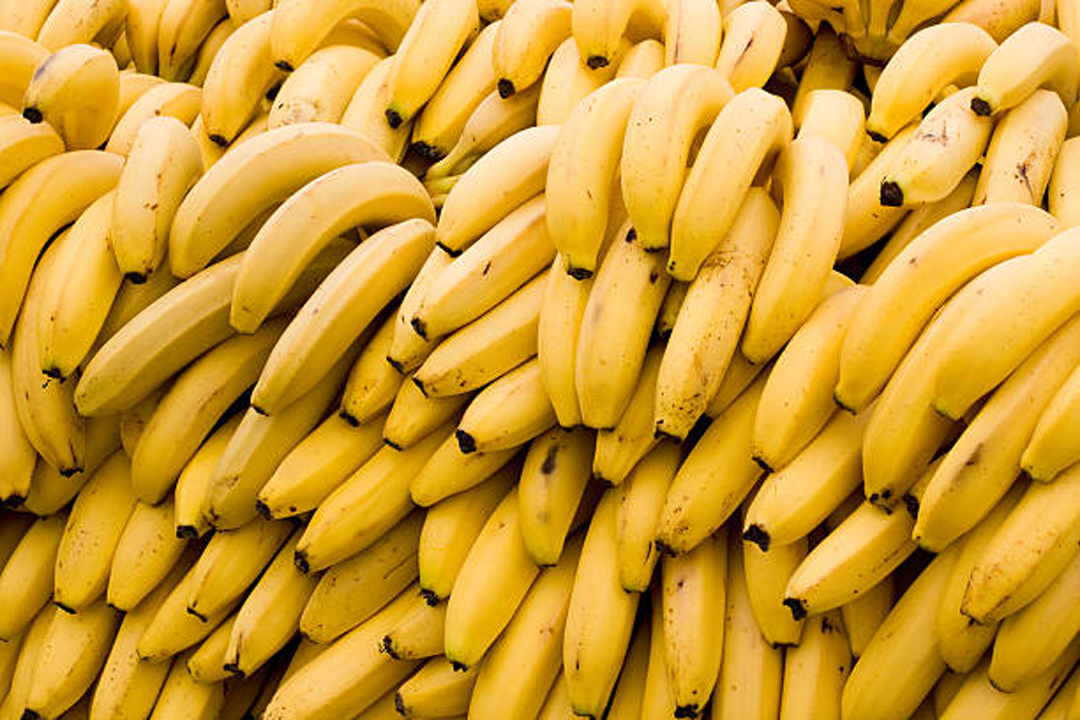
There are many varieties of banana plants. They can grow from 1-25 feet high, according to variety. They have straight trunks, and the green stems carry very large green leaves. The huge pendant flowers are spectacular and vary in size, color and shape depending on the species, as does the fruit that follows. Banana fruit hangs in dense clusters or “hands.” and each banana is called a “finger.”
History and mythology
The banana family is native to tropical regions throughout the world, where the hot climate ensures ripening of the fruit. Banana plants are said to have originated in the region from India to New Guinea, then to have been introduced into Africa by the Arabs, and taken later into America and other colonies by the Spanish and Portuguese. Banana leaves are used as a herb in many countries where the plant grows.
Cultivation
Banana plants must grow in rich soil in a sheltered sunny position. Plenty of water is needed, and a damp part of the garden is ideal for them. Once the tree has flowered and fruited it will not do so again, so it is necessary to cut the trunk away to allow new suckers from the parent plant to grow.
Harvesting and processing
Banana leaves may be used at any time for wrapping various foods before cooking. The leaf stems are also employed by peeling away the outward fiber until the pale green, or white, porous middle portion is revealed. The flowers also have their uses and are picked fresh, or are pickled. Harvest the fruit in clusters, usually at their peak in autumn.
Various uses
Culinary
Banana leaves are used for their aroma when wrapping food such as rice and fish, before steaming; the leaves are first soaked in boiling water to make them pliable.
The peeled stems may be cut into pieces and added to salads for taste and texture, or may be steamed with vegetables. The Burmese put the prepared, chopped stems into a special curried soup which thus gains an additional, subtle aroma. In some Southeast Asian countries it is a custom to serve curries on a banana leaf instead of a plate.
Banana leaves are used in Mexican cuisine to wrap tamales, dishes of fish, or chicken. The tamale is also made in South America: it begins as a dough surrounding a seasoned filling of vegetables, or meat, fish, or poultry. Banana leaves are preferred to wrap tamales because of their excellent taste. The prepared leaves are passed through an open flame to bring out the natural oils and flavor, or they can be dipped in boiling water for a milder taste. The tamales are then wrapped and steamed, or slowly simmered.
Packaged banana leaves are available in Latin American and Oriental markets.
Medicinal
Though banana leaves are valued for their aromatic flavor, it is the fruit which is richest in nutrients, containing sugars, fiber and protein.