

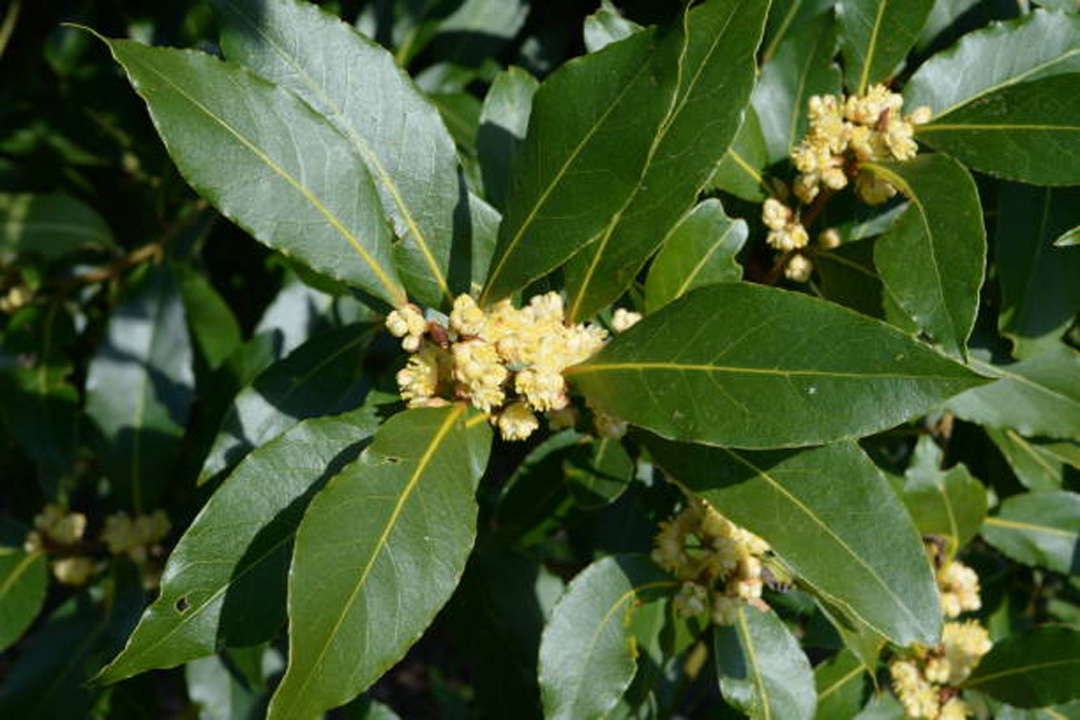
The bay is a very large, attractive tree, thickly covered with glossy, dark green leaves, which are narrow and approximately 4 inches (10 cm) long. When broken, they give off a warmly pungent aroma. Bay trees make excellent tub specimens, especially if grown as standards, when the lower branching stems are cut off and the tops are pruned into rounded shapes. In Europe and America they are often grown like this, either in gardens or on each side of a doorway, particularly in front of hotels and clubs. They look very elegant when treated in this way. The bay tree is native to the shores of the Mediterranean and among its popular names are “sweet bay,” “bay laurel,” “Roman laurel,” “noble laurel,” and “true laurel.” There is another type of laurel, the cherry laurel (Prunus laurocerasus), which is poisonous and must not be confused with the bay tree. In spring, the white flower buds burst into waxy, cream blossoms with pronounced yellow stamens. When in flower, the tree is continually visited by swarms of bees. The flowers are followed by purple berries that go black and hard when dried.
History and mythology
When looking at this tree growing in our gardens, or when using the leaves in cooking, it is interesting to think about the old traditions and history associated with the bay. In early Greece and Rome, the greatest honor for those who were victorious on the battlefield, and in the sports arena, was to be crowned with a bay laurel wreath as were outstanding men of letters too, hence the title of “poet laureate.” The bay laurel was a part of pagan temple rites and ceremonies.
Cultivation
To propagate bay trees, cuttings are advised, as the seeds do not germinate readily. The seeds are about the size of a pea and are very hard, like a nut. It is necessary to sow them at least 1 inch (25 mm) below the soil’s surface. Do not be disappointed if there is only about 5 percent germination. Cuttings are taken when the new spring leaves have hardened. Each cutting should be 6 inches (15 cm) long, and of new wood. Break the cutting away from the old wood, leaving a heel ¼ inch (6 mm) long, which must be trimmed carefully with a sharp knife to eliminate any bark which overhangs the heel. Strip the bottom leaves off the cutting, leaving two-thirds of bare stalk to press into a pot of wet river sand, firming it in with the fingers. Keep cuttings soaked at all times. At the end of spring they must have prepared roots and will be prepared to plant out into containers holding potting mixture. It is always advisable to establish slow-growing plants such as bay trees in pots for at least a year, rather than put them straight into the garden. Bay trees are susceptible to white wax scale, which makes the foliage sooty and unattractive, and also causes poor leaf growth. This can be controlled by spraying with white oil in hot weather, or scrubbing the affected places with soapy water.
Harvesting and processing
The leaves can be used for cooking at any time during the year. If you wish to dry them, the best way is pick the leaves off the stalks, then spread them out on a wire rack, where they will dry quickly with a good, green color. An alternative is to hang leafy branches in bunches in a dark, airy place.
Various uses
Culinary
Bay leaves are indispensable in many different types of cooking. For instance, a bay leaf is an essential ingredient in a “bouquet garni,” or savory herb posy, the other herbs being a spray each of parsley, marjoram, and thyme and a few peppercorns. These are tied together and dropped into casseroles, soups, or stews, and removed after cooking. Or, the dried herbs, including the bay, may be crushed and crumbled together to make a blend, which is then put straight into the pot and left to amalgamate into the stock during cooking. As a variation, when cooking an Italian-type casserole or soup, add oregano and a little garlic and leave out the marjoram and thyme.
For fish, replace the marjoram and thyme with dill. For lamb, replace the marjoram and thyme with rosemary. Bay leaves on their own flavor soups and casseroles; boiled, baked, or steamed fish meat and poultry. A bay leaf gives a pungent aroma to marinades, and if a leaf is placed on top of a milk pudding as it goes into the oven, a subtle and unusual flavor is imparted.
Bay leaves are used widely in Middle Eastern and Mediterranean cooking in such dishes as meat stews, and in marinades for lamb and fish. In Arabic a bay leaf is called “warak al gar,” in Turkish, “dafne yepregi,” and in Greek, “thaphne.” Bay leaves are known as “bai krawan” in Thailand.
Medicinal
There has been found in the bark of stem and root, volatile oil, starch, several acids, resins, and a red coloring substance. The bay had an important place in early medicine. Externally, an oil from the leaves and berries was applied to bruises and sprains. The oil was dropped into the ears to reduce pain and was used to cure hysteria, rheumatism and flatulence. The powdered berries were sometimes prescribed to improve the appetite and cure fevers.
Cosmetic
A facial steam bath containing herbs to clear the skin was popular with our grandmothers and has become so again today. For normal skins, a mixture of bay leaves, chamomile flowers, rosemary, and rose petals is recommended. Dried bay leaves go into potpourri blends and, with other soothing herbs, into sleep pillows for insomnia.
Companion planting
We have found that other plants will grow happily near pungent bay trees, except when the tree becomes too large and the roots rob the nearby soil of nourishment.