

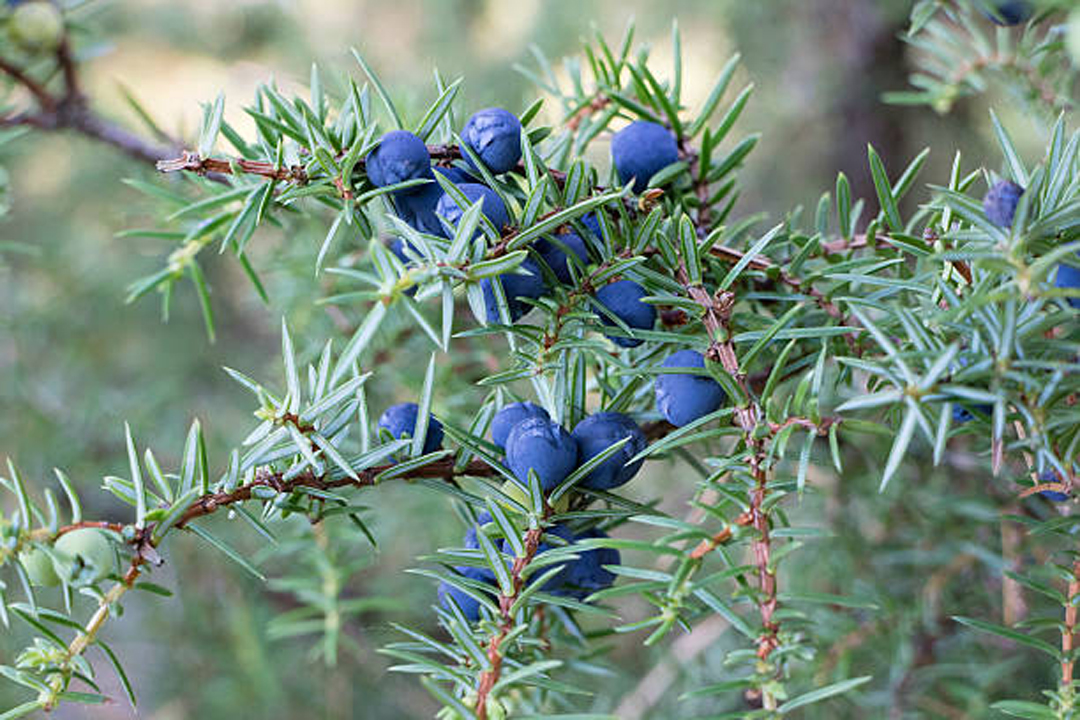
The evergreen tree from which juniper berries are gathered is a neat conifer, described as a tall shrub or small tree, and is both useful and ornamental. The tiny blue-gray needle-leaves are tightly packed onto intricately woven thickets of tan branchlets densely covering the juniper from top to bottom. The miniature flowers yellowish on the male, pale green on the female are hard to see when they appear in early summer. These are followed by small, fleshy, green cones on the female tree only; they are known as berries, and contain three seeds each. When the berries ripen, they turn from green to bright navy blue flushed with a faint bloom, and are then ready to be picked and dried. While the berries are maturing, new cones are forming on the tree at the same time. There are other varieties of junipers, not so well known, including dwarf and prostrate forms. We once saw a golden, horizontal juniper growing vigorously in an earth-filled stone well, high above the Pacific Ocean. Noting the profusion of ripe berries, we thought, “surely not?” and dared to pick and taste the flavor was identical to the common variety. Juniper trees are widely distributed throughout North Asia, Europe, North Africa, and North America.
Cultivation
Fresh, ripe seeds may be sown in prepared boxes in spring, and kept moist to enable germination. A quicker way of starting a tree is to propagate hardened tip cuttings in late spring in mild zones, or in autumn (fall) in cold climates. Put 4 inch (10 cm) cuttings into a pot of sand and keep lightly watered; roots will form quickly. When large enough to handle, plant out the seedlings or cuttings into well-drained soil in a sunny to semi-shaded position: they do best in limy alkaline or chalky ground. Junipers are reasonably fast growers, but once the green berries have appeared it will be about two to three years before they turn dark and are ripe enough to pick.
Harvesting and processing
When harvesting the fruit, put on stout gardening gloves and carefully, pruning shears ready, thrust your hand into the sharp protective foliage, and snip off the berries. Let them dry out a little by spreading them out on a shelf or airy rack, then put into airtight containers. They will go darker when dried.
Various uses
Culinary
Juniper berries have a sweetly sharp taste and a clean, resinous aroma reminiscent of pine forests; what is more, they give a unique flavor to certain foods. In France, juniper berries are included in many stews and casseroles; and in Germany, when a few are lightly crushed, they are a favorite addition to sauerkraut and coleslaw. These berries are the ideal complement to game dishes such as duck, grouse, quail, hare, rabbit, and venison. For a different and subtle aroma in a stuffing for chicken, duck, goose, or turkey, add 6 to 9 crushed juniper berries to the breadcrumbs and herbs. The back of a wooden spoon flattens them easily, thus allowing the release of their delicious (and helpful) essences during cooking. Small burning branches give the same piney scent to meat and fish when barbecuing them. The aromatic globes also provide flavoring and some medicinal properties to gin and some liqueurs.
Medicinal
Besides having so many culinary uses, juniper berries are just as valuable in herbal, homeopathic, and veterinary medicines. It is the essential oil within the berry which has valuable constituents, including antiseptic properties, and is most effective just before the ripening and darkening of the fruit. (The leafy branchlets also contain much of the same substances.) The medicinal action relieves flatulence, helps release fluid retention in kidneys and bladder, and is helpful taken as a tea for menstrual problems. It is effective in alleviating gout, chest complaints, rheumatism, and arthritis; it stimulates blood circulation, is good against internal infections, and is a helpful tonic to increase the appetite. Herbal tablets consisting of juniper with celery seed make an excellent combination to tone up the kidneys and bladder and to lessen muscular aches and pains. It is strongly advised not to take juniper at all when the kidneys or bladder are inflamed, or during pregnancy. Externally, juniper oil broken down with olive oil is helpful in relieving aching joints and certain skin disorders. Some herbalists recommend juniper oil as an inhalant for bronchitis. The leafy branches also have antiseptic qualities and are a time-honored method of fumigation.
Cosmetic
A facial steam prepared with a few drops of juniper oil, or the leafy twigs steeped in boiling water, is helpful in treating skin eruptions such as acne. Afterwards, dilute some pure olive oil with juniper oil, and gently smooth over the affected area.
Companion Planting
On the farm, it has been found that most animals, especially sheep, like to eat the berries, which help to prevent or alleviate dropsy.