

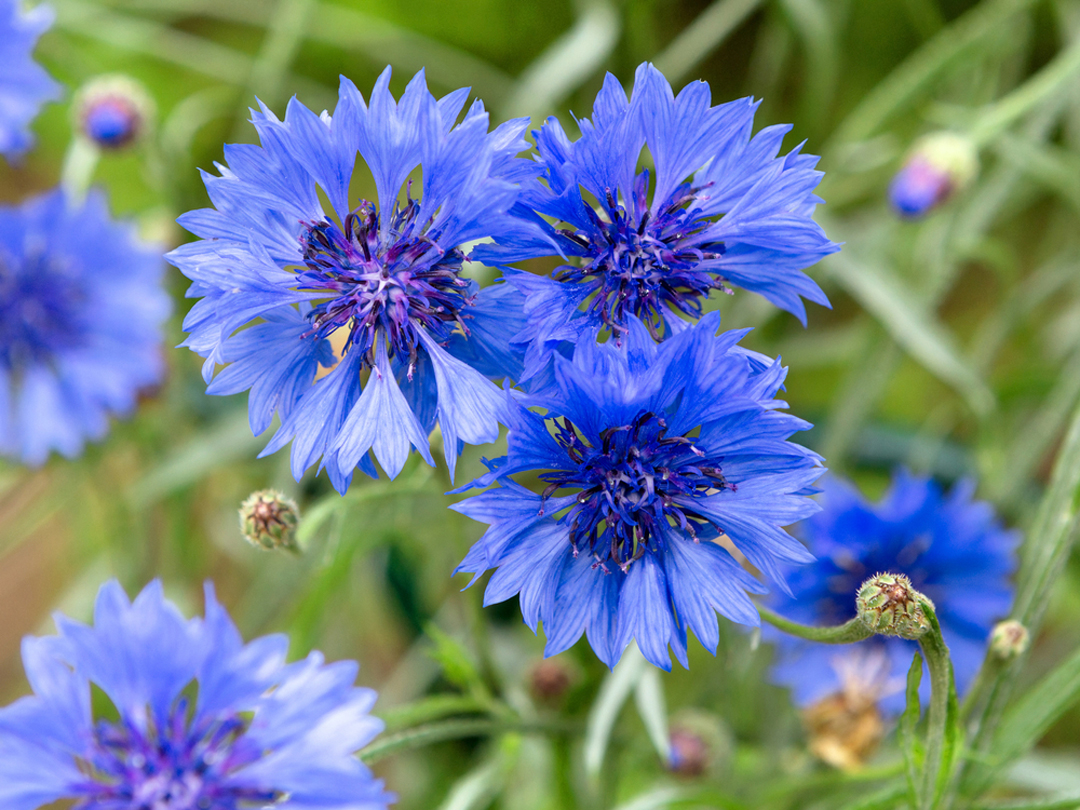
Cornflower covers the golden grain prairies from late Spring onwards with its gracious blue flowers. From ancient times, the seeds of crops have been mixed with cornflower seeds, and have been dispersed all over the world. Pliny the Elder, a first century Roman naturalist, described the corn¬ flower as “an annoying flower for reapers,” who surely tried not to cut it with their sickles and scythes. A few other words have reached us from the classical writers about this delicate plant
Its medicinal virtues were discovered by Mattioli, a sixteenth century botanist who declared that “the blue flowers of the cornflower alleviate reddened eyes.” The healing virtues of the plant were due, according to Mattioli, to the combination of opposed colors, blue versus red, in compliance with the theory of signs.
At present, herbicides and selection processes of crops are terminating with cornflower as if it were an¬ other weed.
Plant Description
The plant belongs to the family of the Compositae. It has a thin, stiff stem, which grows up to 50 cm high. It has composite, bright blue-colored flowers, and narrow leaves which appear to be covered with a smooth velvet layer
Habitat
It mostly grows in crop fields all over Europe, though It has reached America as well. It is less frequent in the southeastern regions of Europe.
Chemical Content
Cornflower flowers contain anthocyanin, which have antiseptic and anti-inflammatory action. Their infusion produces an improvement in the blood circulation in the retinal capillaries, besides having appetizing and eupeptic effects.
Properties and indications
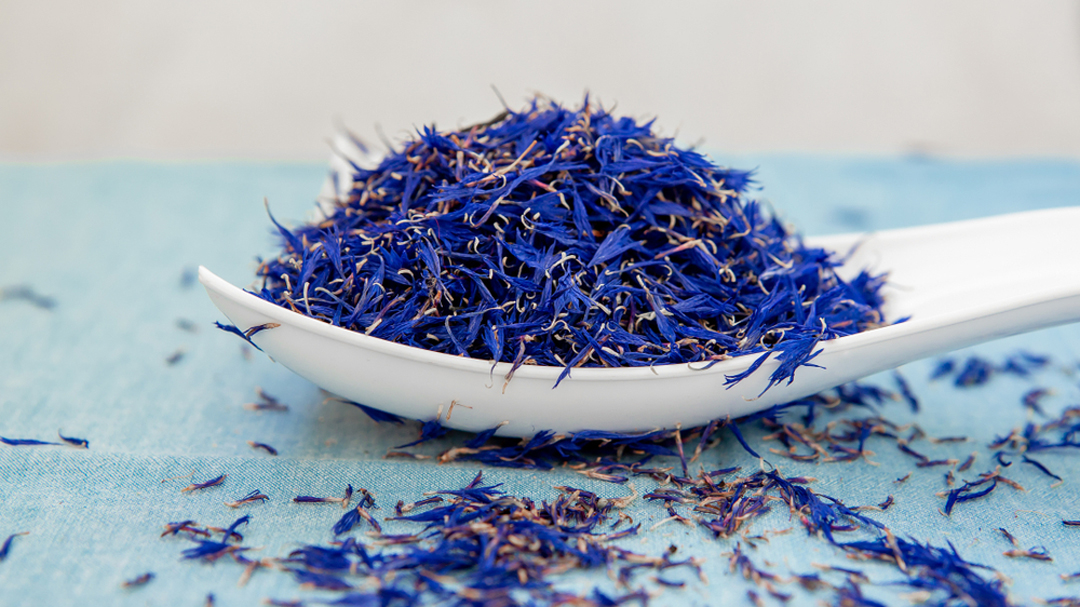 Flowers contain andiocyanins and polyines, whose action is antiseptic and anti-inflammatory, bitter substances which act as appetizers and eupeptics (that facilitate digestion), and also flavonoids that have a mild diuretic effect.
Flowers should be taken in infusions before meals. It is better not to sweeten the infusions.
- Cornflower water: Obtained by the decoction of its flowers, is primarily used in applications on the eyelids, due to its notable anti-inflammatory effect. Eye irrigation and baths with cornflower water ease itching and eye irritation, besides giving a fresh and smooth look to tired eyelids. Thus, in many places this plant is given the name of “bags-under-eyes.” People who wash their eyes with cornflower water obtain a limpid and shimmering gaze, which flashes just like the cornflower’s little blue flowers in golden wheat fields. These are the most important indications of cornflower water.
- Conjunctivitis: Inflammation of the mucous membrane that covers the anterior part of eyes. Eye cleansing with cornflower water, as well as eye drops, will help to eliminate eye secretions (sleep) and to make eye congestion disappear.
- Blepharitis: Inflammation of the eyelids and styes (little furuncles which appear in the edge of the eyelids) In this case, the application of cornflower water in compresses or in eye baths is recommended.
In ancient times, the cornflower was supposed to clear and preserve vision, although only that of blue-eyed people. Thus, in French this plant is called casselunettes (glasses-breaker). Today we know that this was merely a myth, nevertheless we should remember that cornflower is good for the eyes.