

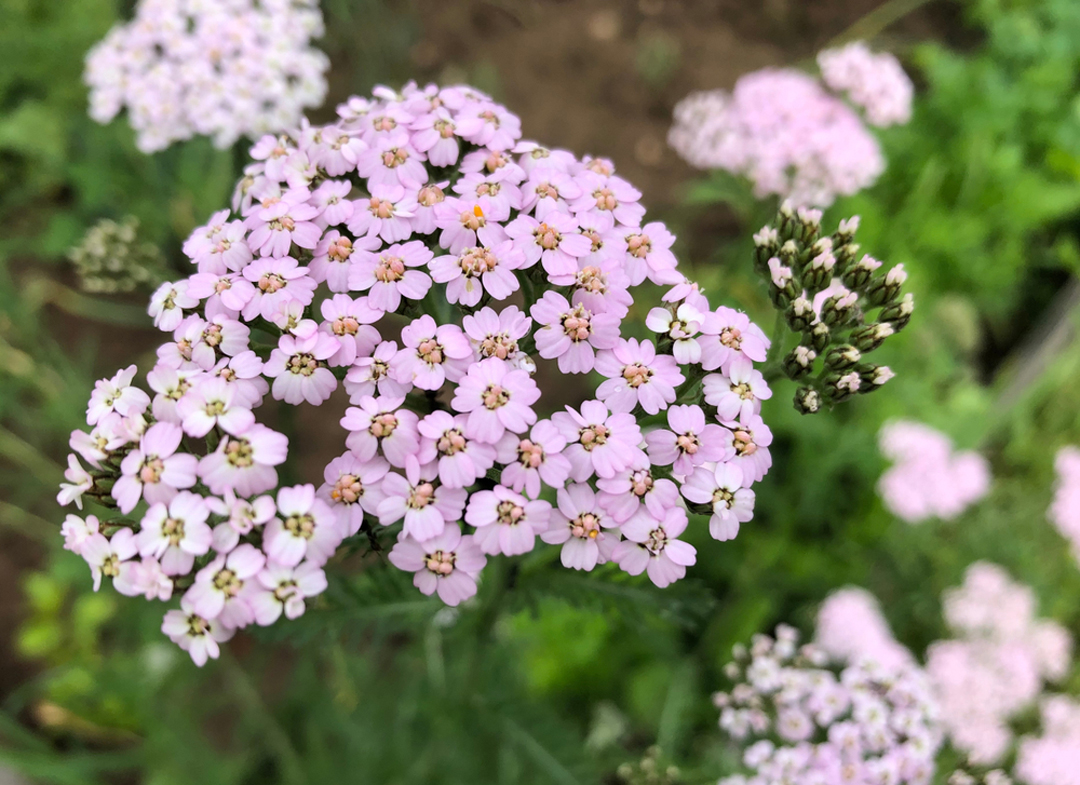
Yarrow is highly regarded for its many therapeutic qualities. The plant has thickly matted, tufted foliage growing from spreading, tenacious roots. Each leaf stalk has a myriad of finely cut, tiny leaflets neatly arranged in pairs along its length, the whole resembling a green feather. The flavor is faintly acid, yet pleasant. Leaves vary in length from 2 to 6 inches (5 to 15 cm) or more, depending on maturity and variety. Blooming from summer to autumn (fall) on erect stems about 2 feet (60 cm) tall, every flower is a composition of many diminutive florets closely packed together to form one flat and even bloom. Colors vary according to variety, and are mainly white, or rose pink tinged with white. There is also a golden flowering yarrow, and an especially ornamental, rare kind with double, creamy white blooms it used to be called “the pearl.”
History and mythology
Yarrow has a number of descriptive folk names in herb lore, indicating its ancient background and diverse uses. The botanical title Achillea comes from the Greek hero Achilles who, legend says, staunched his soldiers’ battle wounds with this herb, while millefolium indicates its profusion of foliage. “Yarrow,” as it is called today, derives from the Anglo-Saxon gaerwe. Its pungent leaves were once prepared as snuff, and this probably accounts for another curious name, “old man’s pepper.” Among yarrow’s many traditional common names are “staunch-weed,” “woundwort,” and “knight’s mil-foil,” all evidence of yarrow’s long-held reputation for staunching blood. It is still used in modern remedies for this purpose.
Cultivation
The quickest way to propagate yarrow is by root division in spring or autumn (fall). If you are doing this in autumn (fall), cut the stalks to ground level first. When there is no parent plant, seed may be sown in spring in prepared boxes. When deciding where yarrow is to grow, choose a sunny position. The type of soil is not a problem as long as the ground is well drained; we have lost yarrow in damp conditions when excess water has remained for too long after heavy ram. Like tansy, yarrow is found growing happily in a wild state, and can become a nuisance if the vigorous roots become uncontrolled: dig out unwanted areas in this case. Yarrow stalks wither when cold weather comes, and should be cut back to their base. New growth will shoot in early spring.
Harvesting and processing
As the whole plant has a variety of medicinal properties, dried stems, leaves, and flowers are mixed together. Therefore it is customary to harvest in late summer when yarrow is in full bloom. Cut flowering, leafy stems in the morning after the dew has evaporated and hang in bunches in a shady, airy place, or spread out on a drying rack until completely moisture-free. Snip flowers off first, pull apart and put on one side; next, strip leaves from their stalks, crumble, and set aside also; then cut up the stems, and blend all parts into one mixture. Store in labeled containers. Some herbal remedies call for fresh leaves, which also have a fairly limited culinary use, but it is mainly the dried herb which is employed in medicine.
Uses of Yarrow
Culinary uses
Yarrow’s fresh young leaves are nutritious, and when a few are added to a salad they give a subtle tang. In some European countries, yarrow has been used instead of hops in brewing beer.
Medicinal uses
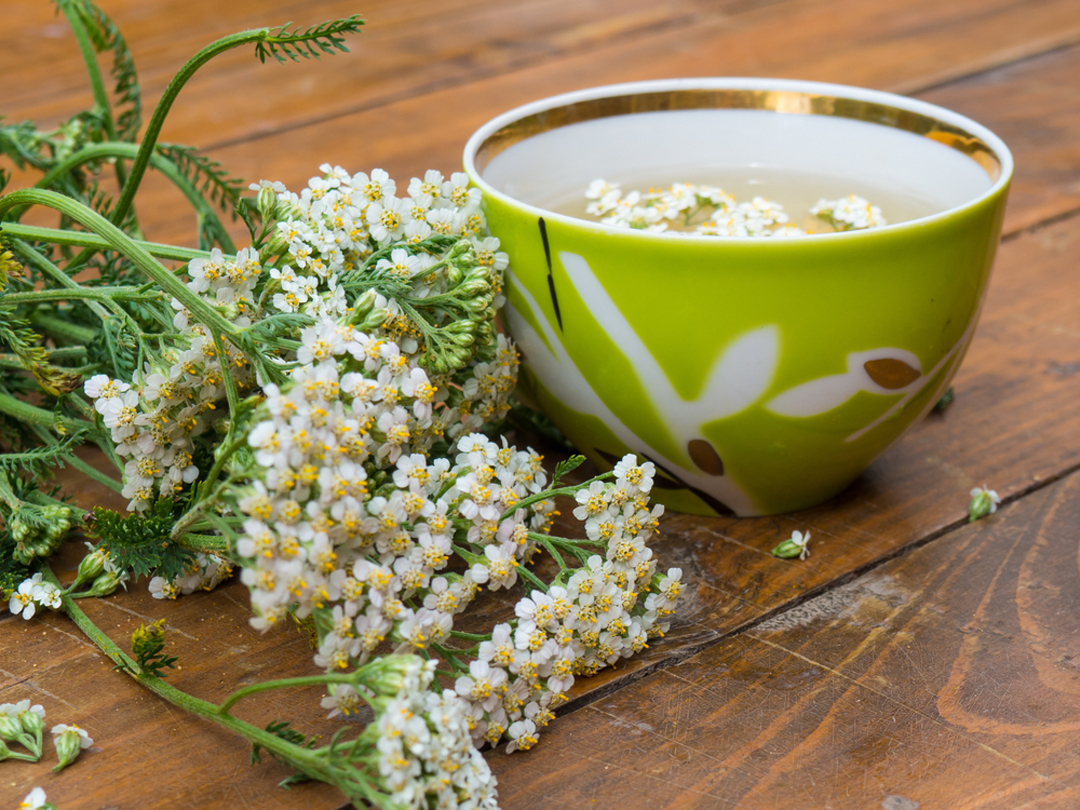
Yarrow has countless medicinal properties esteemed by all who are interested in nature’s healing herbs. Yarrow tea, made from the whole plant as described in the harvesting section, has a powerful tonic effect on the system, and among other uses helps allay fevers, purifies the blood, lifts depression, is good for kidney disorders, and is said to prevent baldness when used as a wash. The green herb is sometimes made into an ointment for healing wounds; fresh leaves can also be infused and made into a wash for the same purpose. Yarrow can be used for menstrual problems, and in this case should be taken under supervision. It also has a reputation for “staunching” blood, and once again, should be expertly administered. It is always advised not to overdo drinking yarrow tea as various side effects can arise if taken too frequently. The effect is greater therapeutically when the need is there.
Cosmetic uses
A wash made from cooled yarrow tea helps to heal chapped hands. If you have a greasy skin, take a course of weak yarrow tea, drinking two cups a day: use the cooled tea also for bathing the face. One herbalist warns that extended use of yarrow tea may make the skin sensitive to light, so for cosmetic use, be especially watchful.
Companion plants
Planting It has been noted that yarrow plants increase the aromatic quality of other herbs and vegetables, while helping them resist adverse conditions. Yarrow is also an excellent compost activator, altogether making it a good therapist for the garden.